
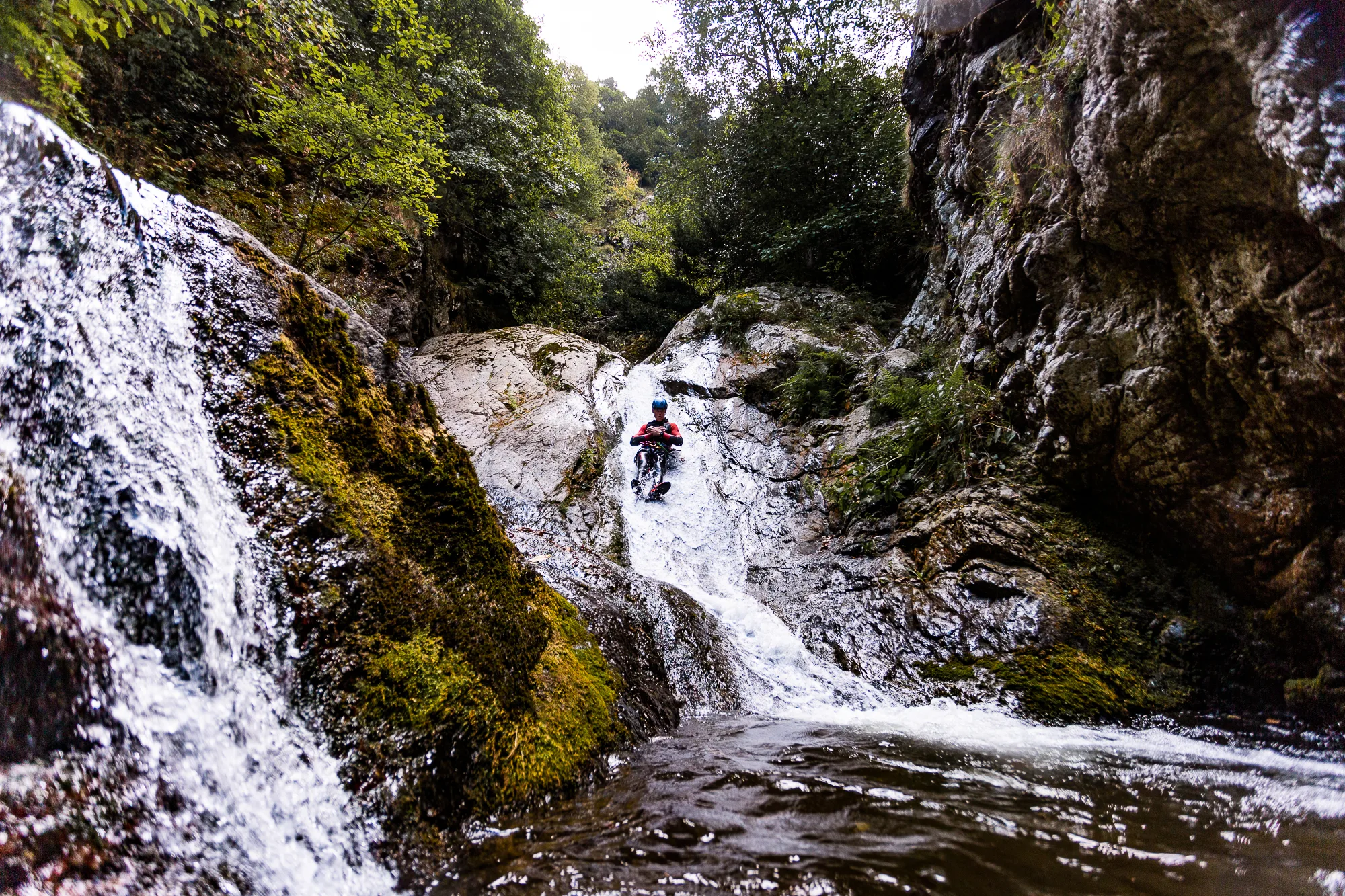
Canyoning, pronounced "can-yon-ing", is one of the most beautiful outdoor sports there is. You follow a gorge, a canyon, from top to bottom, usually with a river or stream running through it. Along the way you walk, climb, rappel, swim, slide and jump.
You reach places you would otherwise never see: deep between high rock walls, past waterfalls and clear pools carved by water over thousands of years. The combination of height and water gives a real kick, and no two trips are the same.
Where do you find canyons?
Not in the Netherlands or Belgium, sadly: they are too flat. A canyon forms where water has enough height difference to grind its way into the rock. Rain and meltwater look for the fastest way down and, over thousands of years, cut out a gorge.
What that gorge looks like depends on the height difference and the type of rock. Some canyons are wide and shallow, called open. Others are narrow and very deep, called closed. The steeper the canyon, the higher the waterfalls and the deeper the pools. Some canyons (temporarily) have no water, because it is too dry or the river has found another route. Most canyons people descend are fairly narrow, with plenty of height difference and water.
In Europe you find canyons in France, Spain, Italy, Switzerland, Austria, Germany and Greece, among others. Further afield, New Zealand, La Réunion and Nepal are true canyoning destinations. Our courses take place in the French Alps; with the expedition team we explore new canyons in New Zealand.
How do you move through a canyon?
Every canyon has different obstacles: a high boulder, a waterfall, a narrow passage or a slide. Each obstacle calls for a different technique.
Walking
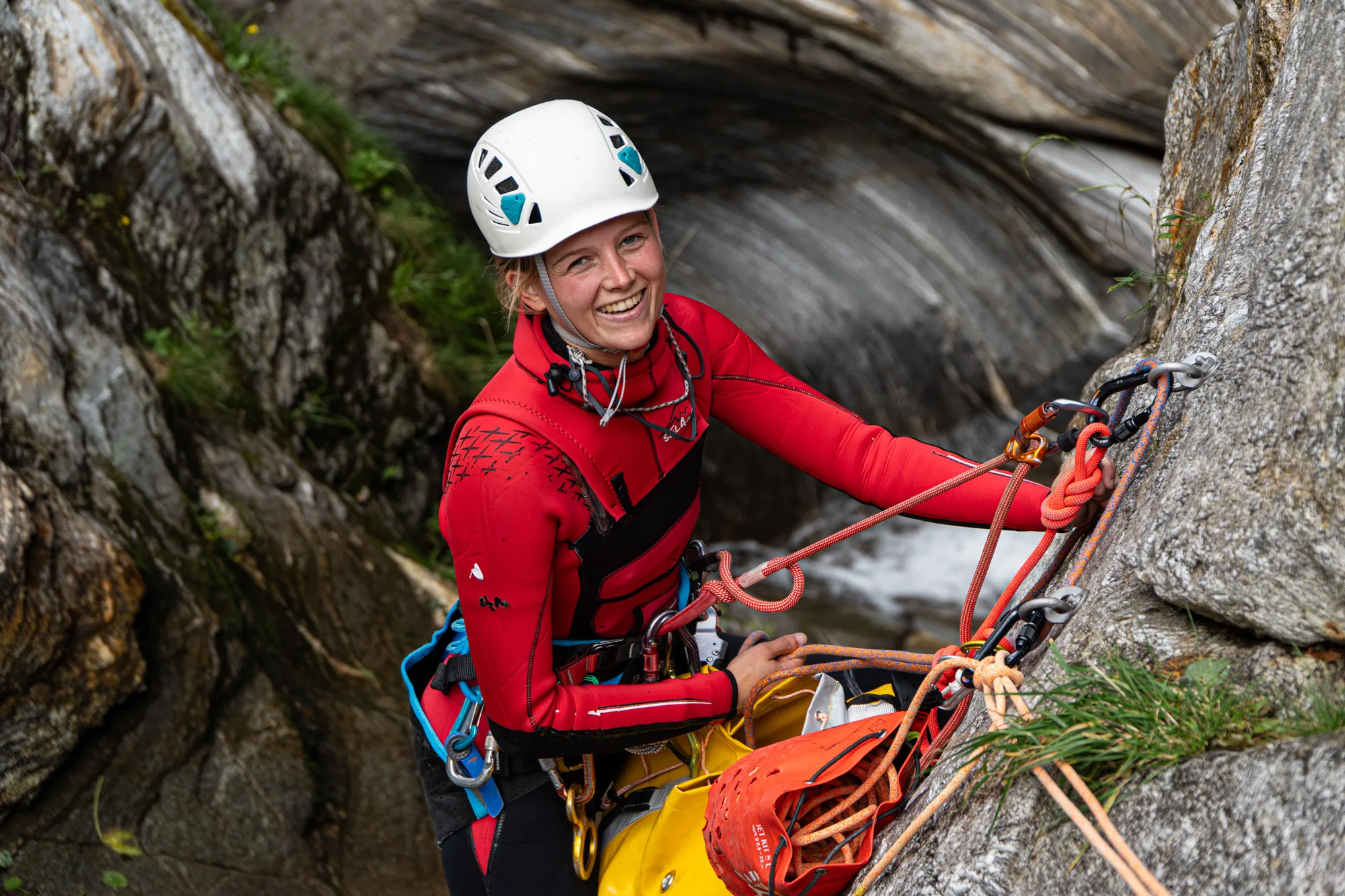
Walking in a canyon is different from walking on a trail. You move over wet, sloping and uneven rocks, sometimes over old tree trunks, and algae make the surface slippery. So you move calmly, with bent knees and a low centre of gravity, using your hands where needed.
Climbing
You get past big boulders and high steps by climbing and scrambling, sometimes on hands, bottom and feet. Your wetsuit protects you from the rock.
Rappelling
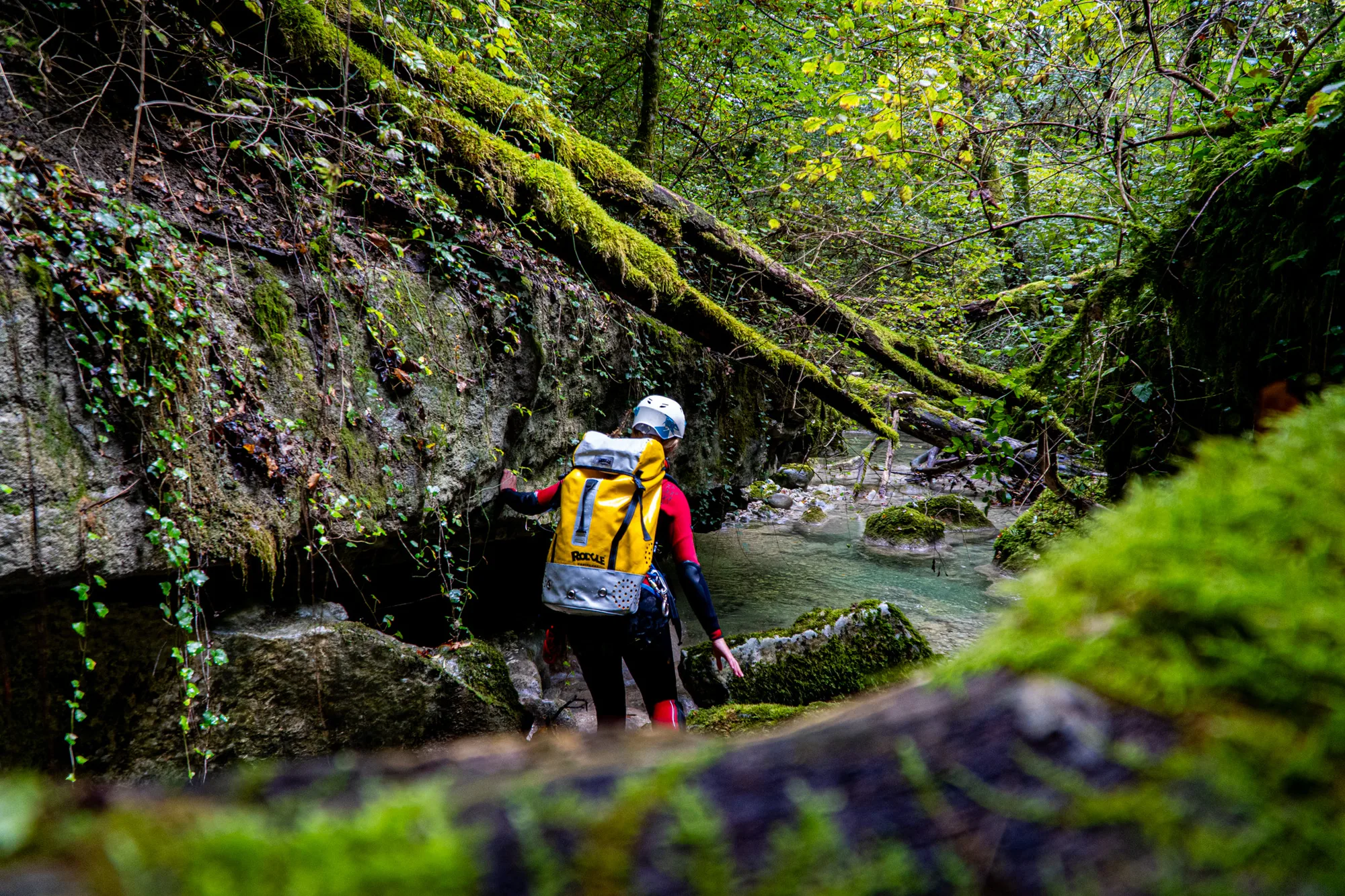
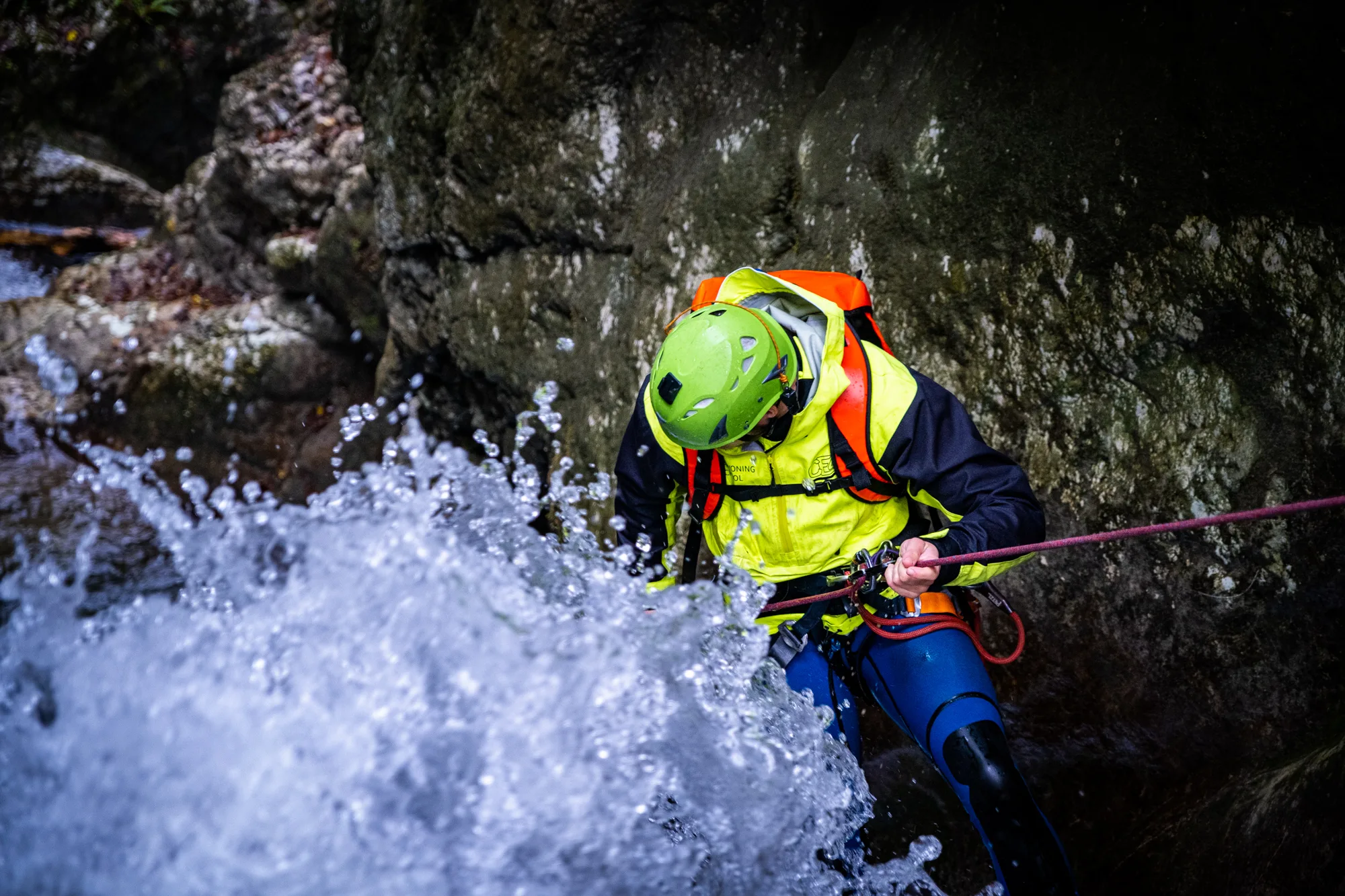
Where you cannot climb, slide or jump, you rappel: you lower yourself in a controlled way down a rope, with a harness and a descender that works as a brake. A rappel can be a few metres down dry rock, or straight through a waterfall and tens or even hundreds of metres high.
Swimming
Running water forms deep pools that you swim through. Your wetsuit gives you some buoyancy. In calm water you swim just like in a pool; in strong current you have to swim hard and know how the water behaves.
Sliding
Sometimes the water has polished the rock so smooth that a natural slide has formed, ending in a pool. You slide on your back, feet first, just like in a swimming pool. The steeper and smoother, the faster you go.
Jumping
If the pool below a rock is deep enough, you can jump, from a few metres to sometimes much higher. Good technique matters, and you always check first that the water is deep enough and nothing is hidden below the surface. The higher the jump, the harder the landing.
What do you need?
The rock can be sharp and the water is cold. Good protection matters:
- A wetsuit, usually 5 mm thick, to keep you warm and protect you against knocks
- A helmet against falling rocks and for when you fall yourself
- Sturdy shoes that protect your feet and ankles and grip on wet rock
- A harness with a descender and carabiners for rappelling
- Safety lines to secure yourself at an anchor or along a handline
- Static rope to rig the rappels
- A canyoning backpack with drainage holes, and a waterproof keg for food, a first aid kit and emergency gear
For a course you do not need to own everything: you can rent equipment from us.
How difficult is a canyon?
Canyons are graded on three points, for example V3A3II:
- V (vertical, 1 to 7): how high and technical the rappels and climbs are
- A (aquatic, 1 to 7): how much water there is, and how strong the current, jumps and swims
- I to VI (commitment): how long the trip takes and how easily you can get out if needed
A canyon with a low grade suits beginners with a guide. The higher the numbers, the more experience, knowledge and independence you need.
Learning to canyon safely
Canyoning is beautiful, but water and rock demand respect. High water after rain, thunderstorms, cold water and falling rock are real risks, and in many canyons there is no way back after the first rappel. So only go canyoning with a qualified guide, or when you have enough knowledge and experience yourself.
You build that knowledge step by step. At Whio Canyoning School we follow the training structure of the Dutch Canyoning Association: from the introduction course to Canyoneer M3, and on towards guiding. Want to try it first? Join one of our free canyoning days or a training day.